Herzog Articles
Ranking the Werner Herzog Documentaries
Ranking the Werner Herzog Fiction Films
Review of Werner Herzog’s The Twilight World
Ranking the Nosferatu Films
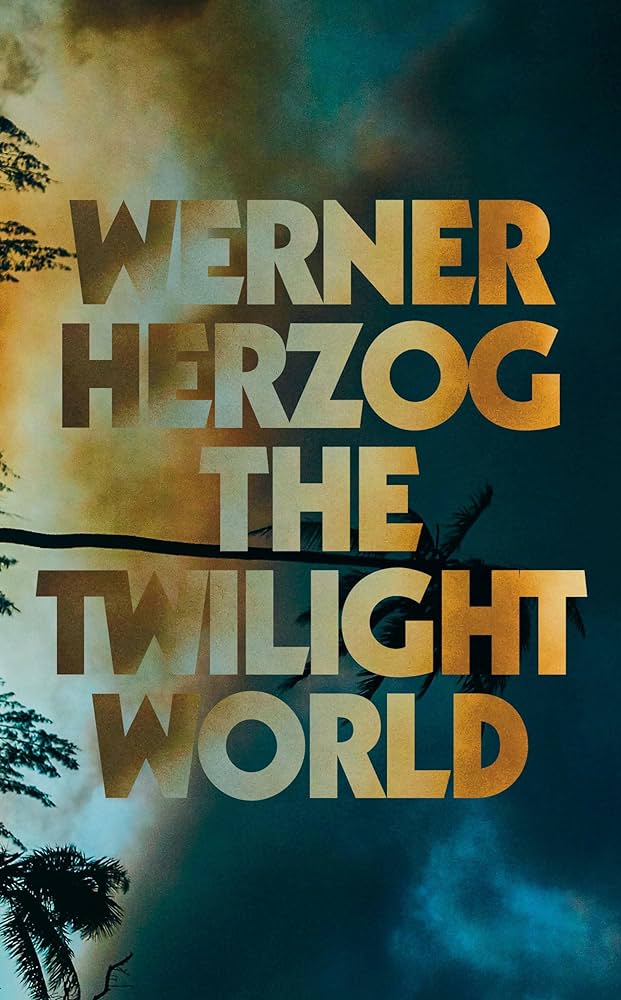
The Twilight World explores so many ideas and themes that Werner Herzog has been examining for the last 55 years on screen that it hardly feels weird that it is coming in a previously unexplored form for the man: a novel. While most genius artists who have attempted to tackle new modes of making art often fall flat on their faces, Herzog deftly avoids that by sticking to what he has mastered. He takes a subject that in some way, shape, or form that is on the margins and does a deep-dive empathetic portrayal of the subject (all the while utilizing his infinite capacity for curiosity to guide him).
The story of Hiroo Onoda – an infamous Imperial Japan soldier who defends an island on behalf of the military for a full thirty years after World War II has ended – feels like such a natural subject for Herzog to examine that you never stop to question why you’re reading the auteur’s words instead of listening to his trademarked narration. As seen in his documentaries like Happy People: A Year in the Taiga and Nomad: In the Footsteps of Bruce Chatwin, Herzog if nothing else seems to have a fascination with those who live as far away from modern society as possible. He is uniquely talented at dropping into a world he is not a part of or does not belong to and managing to tell a story that seems to authentically capture a tiny piece of the community’s existence and life itself. He is equally talented at managing to capture his subject’s essence – a taste of their humanity.
From there, one cannot help but see the connection between Herzog’s portrayal of Onoda’s story (in both positive and negative ways) with many other Herzog works. There are the many obvious similarities to Herzog’s examinations of other soldiers, fictional and real. There is his Woyzeck where Herzog looks at a low level German soldier (played by Klaus Kinski). How far can a person be pushed? How much shit can they eat? Before they finally snap. Herzog shows life shitting on him over and over, and then you get to experience Kinski progressively get more and more unstable until he finally cannot take it anymore.
Onoda, almost completely single-handedly, continued to defend an island long after WWII because the orders he received were never formally rescinded at any point. Thirty years of his life were taken from him. And yet, he would not break. He would not stop until his old superior came to the island to relieve him of his duties. Why?
Herzog more famously looked at the real life Vietnam vet Dieter Dengler in both a documentary (Little Dieter Needs to Fly) and a fictionalized-issue film starring Christian Bale (the far inferior Rescue Dawn). There Herzog explored the contradictions of a man who survived Nazi Germany only to end up as an American prisoner-of-war who refuses to sign a letter criticizing the U.S…in the Vietnam War.
Onoda was in some ways the last formal soldier of imperial Japan. He is the last soldier representing a horribly oppressive force in the Eastern world. Yet we cannot help but be drawn to him. Why?
Herzog also much less famously (thankfully) made the film Little Soldier. No other film (perhaps besides Rescue Dawn) can serve as a better showcase for Herzog’s blindspots as an artist. Herzog is not interested in contextualizing the conflicts that are being shown on screen. The reasons that led these subjects to these conflicts are tragic. Herzog is much more interested in the latter than in the former, and those choices in “where to cut” can leave his documentaries lacking.
Imperial Japan’s military is not really something to look fondly back on! Onoda was a participant and a true believer in an oppressive military force. Herzog makes no attempt to contextualize Onoda’s place in the world. And yet we are drawn to his journey and recognize his humanity. We do not see him as an agent of an oppressive force. Why?
Herzog’s ability to do just that is reminiscent of his remake of Nosferatu The Vampyre. Herzog displays a rather touching empathy for Count Dracula here, as it is not hard to imagine that Herzog would be drawn to a character doomed to experience life for all eternity without anyone to love him.
In Nosferatu though, the cycle of destruction continues anew. Dracula dies, but he turned Jonathan Harker into a vampire that presumably is going to start a new wave of death. Onoda is not cursed to such an intimately grim ending. He perhaps experienced near-eternity in solitude and without anyone to love him, but he does not pass down his wretched existence to anyone else.
The ending of The Twilight World is possibly much more existentially tragic. Onoda returns home finally to discover post-war Japan is nothing to romanticize (not that Imperial Japan was either). He was “distressed by the materialism of postwar Japanese society” and thus, whether he realized it or not, he became distressed by the conservative movement put in control to dominate Japan as it settled into its newfound, subservient role among the world powers. Onoda self-exiles halfway across the world, no longer seeing himself in the place he was from and for which he gave too much.
It is a dour ending that harkens back to Herzog’s Cobra Verde. The (truly evil) protagonist in Verde is fruitlessly trying and failing to drag a ship into the ocean by himself so that he can leave Africa. Individualism will in fact get us nowhere. Collaboration and communication are required to set sail and the only way of building a better world. Are we capable of doing that?
 The Reel World