
RaMell Ross is clearly one of the most interesting and exciting new-ish filmmakers on the scene After making a splash with his debut in 2018 in documentary form, he reached new levels of acclaim with his first fiction film, an adaptation of the celebrated novel from Colson Whitehead, The Nickel Boys. His career will be one to closely pay attention to in the years to come.
3. Hale County This Morning, This Evening [2018]
 RaMell Ross’ debut film is documentary that aims to be anything but ordinary. Ross films various residents from Alabama’s Black Belt. The film shows working class black people living their lives, talking about their aspirations, and just plain old existing. It is a film as much about form as anything else. It forgoes linear storytelling to instead spend time with the people and seemingly tries to get a sense of their lives. It leads to a complicated reaction for the audience. Is there a moral way to gaze at someone’s life? Is this exploitative? Is this pointless? Are these the right questions? I need to sit with this one for a while. If nothing else, I could not keep my eyes off of it. I think I see what Ross set out to do here. In the most literal sense, I do not know if he was successful. I do not mean that in the condescending, paternalistic way – I mean I literally just do not know what to make of my reaction to this one yet.
2. Easter Snap [2019]

Ross’ followup to Hale County was a sub-15-minute short spent with five men in Alabama processing a hog. This is apparently something of a lost art. The oldest of them is leading the other four men through the process. Then he passes out halfway through the process and receives medical attention from an ambulance and EMS. After he recovers enough, he has to tell them how to do the rest of the process. I dare say there might be some sort of metaphor at work here. Much like his first film, Ross’ crafts a film that is beautiful to look at. The shorter length actually feels beneficial to his documentary style. This film feels like merely saying hello and meeting someone rather than gawking at them. Much like that film, I find myself enchanted even if I cannot fully process why I am or if I am glad that I am.
1. Nickel Boys [2024]
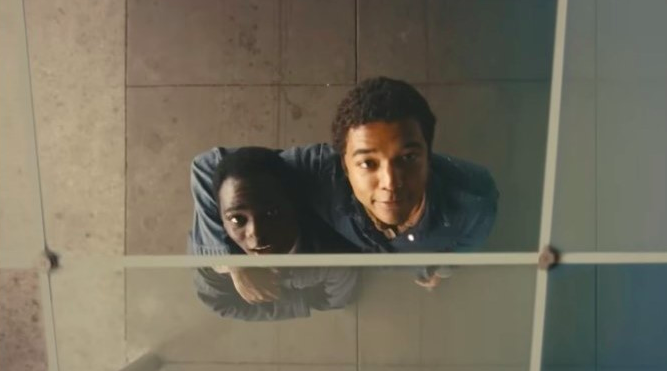
After two documentaries, Ross made his first fiction film. It is an adaptation of the celebrated Colson Whitehead novel, The Nickel Boys.
Colson Whitehead is a frustrating writer. He can come up with a helluva scenario, but there is something far too clinical about his writing. They can sometimes feel like solved equations. There is blood missing from his characters. Whitehead seems to know much about the world and its oppressive conditions, but he has trouble translating into the characters of his books.
RaMell Ross meanwhile has quickly become an expert on making the people he films instantly seem like flesh and blood humans. He has yet to have a dramatic situation to make those talents (though that is not meant as a knock on his documentaries). Combining Whitehead’s premise and Ross’ skills as a craftsman proved to be as perfect of a match in execution as it did on paper.
Ross and Whitehead’s contrasting approaches on how they use art to make sense of the world is frankly thematically perfect for this film as well. Nickel Boys is a film all about POV, both in terms of form and theme.
From the jump, Ross makes sure that almost every single shot of this is from the perspective of a character. Two characters in fact: Elwood and Turner. For the first act of the film, it is only Elwood’s perspective we see (after that it gets more jumbled). Any unease I responded with to Ross’ approach in his documentaries washed away in fiction form. Ross is no longer doing the looking. Elwood and Turner are. (Something about this dynamic shift unlocked Ross’ work for me in a way I will need to continue to sit with.)
Ross does not merely do this as a(n effective) gimmick however. As I wrote, this film is all about POV. Elwood and Turner do not merely see the physical world differently as we all do, they see the conditions of the world differently too. Elwood is an optimist at heart. His optimism as a teenaged black boy in the 1960s American South makes him naive and vulnerable. Turner is a cynic. Turner’s cynicism as a teenaged black boy in the 1960s American South makes him rebellious and vulnerable. This is of course the point: the game is rigged and there is no “right way” to go about things for a black person to survive (let alone thrive) in this double cursed land.
Turner cannot believe things can get truly better. Elwood has to believe things can be made to be better. This clash leads to the tragic finale. It is a tragic finale for far too many black people in this country. After all, this film is not just about the nickel boys like the book is called. This film is about all the nickel boys. Too many young black boys were nickel boys without ever setting foot on a “reform” school plantation.
Nickel Boys is the rare film where form and theme come together to create a truly spellbinding work. It is a must-see event.
 The Reel World